
Showing posts with label Opus 1. Show all posts
Showing posts with label Opus 1. Show all posts
Sunday, October 16, 2016
Load-in at theNAT
Here's what Organ Donor looked like loaded onto the freight elevator for setup at the Natural History Museum.


Tuesday, October 4, 2016
Organ Donor at San Diego Maker Faire 2016
The experience at San Diego Maker Faire 2016 was outstanding in every way. Held at Balboa Park on 1-2 October 2016, Organ Donor Opus 1 was deployed int the Natural History Museum, aka theNAT.
Setup was Friday evening and went as flawlessly as it ever has. The new software that allows for much easier matching of note to valve offered the only real glitch. After three of the hundred twenty two pipes were taught, the cursor started moving all on its own all across the touchscreen. This made it impossible to assign the right pipe to the right valve.
After making sure the wireless mouse was off, the touchscreen connector was re-seated. The problem re-appeared after about twenty pipes. After pondering how what we were seeing could possibly happen, we remembered that the pitch wheels were programmed as cursor movers. The pitch wheels were slightly nudged just enough to key up the on-screen cursors. After the wheels were turned to a neutral location, the problem went away.
We arrived on Saturday and put in 8 hours of hosting. We met a large number of enthusiastic attendees and had so many wonderful conversations! Several important contacts were made, and we were visited by Maker Faire staff to check in at least twice.
Small children generally thin out in the afternoon. This means less banging on the keyboard and more accomplished playing. The only time we stop people from banging on the keyboard is if it's endangering the keyboards. People generally never get to touch a pipe organ. They're always off limits and set off in their own space, or hidden behind walls. Getting to create sound out of acoustic pipes, even if it's a bit dissonant, is a special experience that can spark an entire career. Our goal is to demystify the pipe organ, show what's always hidden away behind walls, explain how they work, and most importantly - let people play.
On Sunday, several extremely accomplished players graced our exhibit, and garnered extended and loud applause. I got a chance to walk around the faire and talk to other exhibitors and enjoy the atmosphere. The amateur radio exhibits were great and the food truck lines were slow.
The most time that Organ Donor wasn't being played was perhaps 45 seconds over the two days.
Late Sunday afternoon, we were visited by Rob Burkhead, our event coordinator, who awarded us the Maker Merit blue ribbon! He passed along extremely high praise for our exhibit, efforts, attitude, and effect. Sol Diego and all San Diego burners should be proud. Without your support and encouragement, Organ Donor wouldn't be at the Faire.
Several other large Faire exhibits were from the burner community, and several booths were staffed by burners. Burners volunteered to help run the event, and lots of burners attended.
If you want a wonderful experience where you can share your art directly with appreciative, inquisitive, positive, and interesting people, then give exhibiting at Maker Faire a chance. Non-commercial booths are free. The process is easy. The hardest part is figuring out parking and setup.
Tear-down was easy and Faire and museum staff were entirely supportive and helpful. I can't say enough good things about how the Natural History Museum helps exhibitors. They know it is a big effort to get your art or exhibit set up. They help you solve problems, get things done, and make you feel appreciated. Plus, you're hanging in the same room with a big old dinosaur skeleton.
The organization that puts Maker Faire on is called San Diego Makers Guild. They are in need of volunteers for planning, organizing, recruiting, volunteering, and staffing. Join up at http://www.sdmakersguild.org
There is tremendous continuing potential for rich and varied representation of all San Diego Burners at Maker Faire (as well as STEAM Maker Faire, San Diego County Fair, and many other events up and down the calendar). Performance art, music, LED arts and crafts, fashion, engineering, structural exhibits, fire art, art cars, engineering tricks, magic, improv - it's all welcome.
We are very much looking forward to coming back to Maker Faire with Organ Donor Opus 2!

Setup was Friday evening and went as flawlessly as it ever has. The new software that allows for much easier matching of note to valve offered the only real glitch. After three of the hundred twenty two pipes were taught, the cursor started moving all on its own all across the touchscreen. This made it impossible to assign the right pipe to the right valve.
After making sure the wireless mouse was off, the touchscreen connector was re-seated. The problem re-appeared after about twenty pipes. After pondering how what we were seeing could possibly happen, we remembered that the pitch wheels were programmed as cursor movers. The pitch wheels were slightly nudged just enough to key up the on-screen cursors. After the wheels were turned to a neutral location, the problem went away.
We arrived on Saturday and put in 8 hours of hosting. We met a large number of enthusiastic attendees and had so many wonderful conversations! Several important contacts were made, and we were visited by Maker Faire staff to check in at least twice.
Small children generally thin out in the afternoon. This means less banging on the keyboard and more accomplished playing. The only time we stop people from banging on the keyboard is if it's endangering the keyboards. People generally never get to touch a pipe organ. They're always off limits and set off in their own space, or hidden behind walls. Getting to create sound out of acoustic pipes, even if it's a bit dissonant, is a special experience that can spark an entire career. Our goal is to demystify the pipe organ, show what's always hidden away behind walls, explain how they work, and most importantly - let people play.
On Sunday, several extremely accomplished players graced our exhibit, and garnered extended and loud applause. I got a chance to walk around the faire and talk to other exhibitors and enjoy the atmosphere. The amateur radio exhibits were great and the food truck lines were slow.
The most time that Organ Donor wasn't being played was perhaps 45 seconds over the two days.
Late Sunday afternoon, we were visited by Rob Burkhead, our event coordinator, who awarded us the Maker Merit blue ribbon! He passed along extremely high praise for our exhibit, efforts, attitude, and effect. Sol Diego and all San Diego burners should be proud. Without your support and encouragement, Organ Donor wouldn't be at the Faire.
Several other large Faire exhibits were from the burner community, and several booths were staffed by burners. Burners volunteered to help run the event, and lots of burners attended.
If you want a wonderful experience where you can share your art directly with appreciative, inquisitive, positive, and interesting people, then give exhibiting at Maker Faire a chance. Non-commercial booths are free. The process is easy. The hardest part is figuring out parking and setup.
Tear-down was easy and Faire and museum staff were entirely supportive and helpful. I can't say enough good things about how the Natural History Museum helps exhibitors. They know it is a big effort to get your art or exhibit set up. They help you solve problems, get things done, and make you feel appreciated. Plus, you're hanging in the same room with a big old dinosaur skeleton.
The organization that puts Maker Faire on is called San Diego Makers Guild. They are in need of volunteers for planning, organizing, recruiting, volunteering, and staffing. Join up at http://www.sdmakersguild.org
There is tremendous continuing potential for rich and varied representation of all San Diego Burners at Maker Faire (as well as STEAM Maker Faire, San Diego County Fair, and many other events up and down the calendar). Performance art, music, LED arts and crafts, fashion, engineering, structural exhibits, fire art, art cars, engineering tricks, magic, improv - it's all welcome.
We are very much looking forward to coming back to Maker Faire with Organ Donor Opus 2!

Wednesday, December 9, 2015
Setup and Configuration at STEAM Maker Festival
Organ Donor Opus 1.2 was set up in record time for the STEAM Maker Festival at the Del Mar Fairgrounds. We had just three hours on Friday and an hour and a half on Saturday morning before the event, for a total of 4.5 hours. The previous record was about 6 hours.
We were able to drive both vehicles right up to the installation site, so very little time was spent carrying parts back and forth. Plus, Richard was there to help.
Over the last few installations, Abraxas has developed a more systematic procedure for placing the air tubes between the wind chest and the pipes. She starts by sorting the tubes by length, and puts the shorter ones in the back. This results in a more orderly arrangement, and less struggle to make all the tubes reach.
Since the last installation, Paul has created a software assistant for configuring the system to match the installation of the tubes. For past installations, we have written the mapping from wind chest to pipes in a notebook, painstakingly checked it over manually for errors, and then manually pressed keys on the manuals to send the programming sequence to the MTP8 MIDI-to-parallel converters in the wind chest. Any error in the latter procedure meant starting over. Now, we press keys on the manuals to tell the software assistant about the mapping. Any duplicate entry is immediately detected and easily corrected. When all the data has been entered, sending the programming sequences to the MTP8s is fully automatic.
The photo shows the screen of the configuration assistant after all the mappings have been entered. I wanted to record the data before doing anything else, just in case there was a problem.

We were able to drive both vehicles right up to the installation site, so very little time was spent carrying parts back and forth. Plus, Richard was there to help.
Over the last few installations, Abraxas has developed a more systematic procedure for placing the air tubes between the wind chest and the pipes. She starts by sorting the tubes by length, and puts the shorter ones in the back. This results in a more orderly arrangement, and less struggle to make all the tubes reach.
Since the last installation, Paul has created a software assistant for configuring the system to match the installation of the tubes. For past installations, we have written the mapping from wind chest to pipes in a notebook, painstakingly checked it over manually for errors, and then manually pressed keys on the manuals to send the programming sequence to the MTP8 MIDI-to-parallel converters in the wind chest. Any error in the latter procedure meant starting over. Now, we press keys on the manuals to tell the software assistant about the mapping. Any duplicate entry is immediately detected and easily corrected. When all the data has been entered, sending the programming sequences to the MTP8s is fully automatic.
The photo shows the screen of the configuration assistant after all the mappings have been entered. I wanted to record the data before doing anything else, just in case there was a problem.

Thursday, December 3, 2015
Organ Donor ready to pack up for STEAM Maker Festival
Organ Donor Opus 1 will be exhibited at STEAM Maker Festival at the Del Mar Fairgrounds on Saturday, December 5, 2015. On Thursday night, all the parts are staged to be packed into two vehicles for transport to the fairgrounds and assembly on Friday afternoon. Here's what that looks like.
Friday, November 27, 2015
New knob for the Organelle
The knob we were able to find commercially was just too small and plain, so we designed and 3D-printed a much bolder knob.
The knob design is published on Thingiverse: http://www.thingiverse.com/thing:1160160
Before the upgrade:


The knob was designed using OnShape.com, a new (still in beta) parametric 3D CAD system that's free to use with almost no restrictions. Worth checking out.
The knob design is published on Thingiverse: http://www.thingiverse.com/thing:1160160
Before the upgrade:
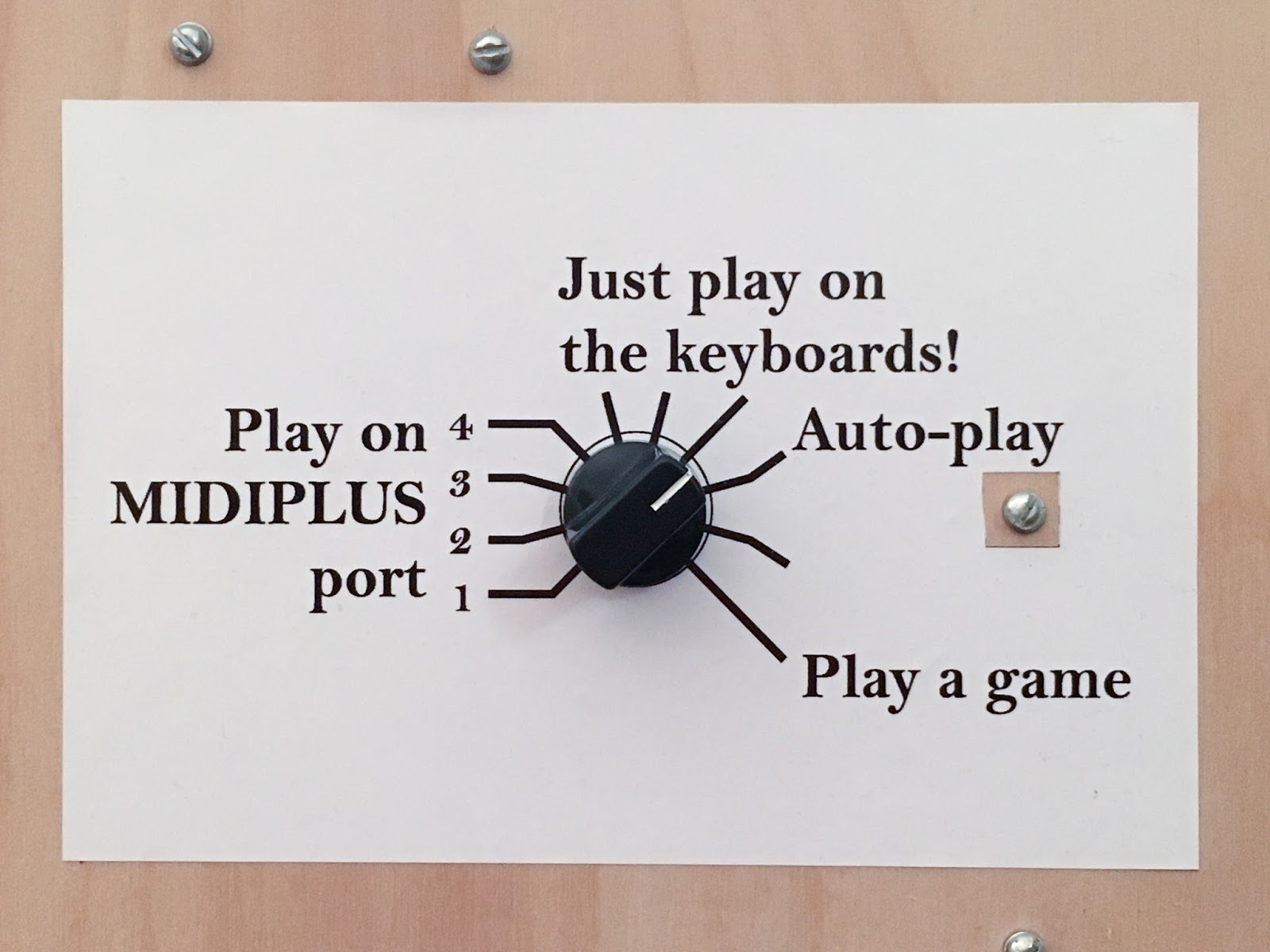
After the upgrade:

Obviously we need to redesign and reprint the panel markings to accommodate this much larger knob.
The knob was designed using OnShape.com, a new (still in beta) parametric 3D CAD system that's free to use with almost no restrictions. Worth checking out.
Saturday, October 10, 2015
Software published
We've caught up on publishing the Organ Donor software to our GitHub project. Not only have we updated the Organelle software to the latest version as of our most recent deployment at the San Diego Maker Faire, but we've also released the Arduino console software for both versions of the Opus 1 console, capturing all the deployed versions back to the beginning.
Tuesday, October 6, 2015

Views from the Balcony
Here are some photos of Organ Donor at the San Diego Maker Faire 2015 in the Natural History Museum in Balboa Park, taken from the balconies above the main show floor. This is an angle we rarely get to see! These were taken on the rainy Sunday morning, when the crowds were thin.

We were asked to keep the aisles clear, so all the long pipes were oriented in the same direction, keeping the layout more compact than usual. This looks a lot like one of our earliest concept drawings of how the pipes would be arranged.

The show floor at the Nat included the luxury of a small cafe, with coffee.

Museums need to have crowd-control stanchions in stock. Here they are keeping people from walking into the long pipes. The railroad track at the lower right is our AC power cord gaffer-taped to the floor. On the small table next to the console you can see the Adafruit UNTZtrument sequencer, connected to one of the four new external MIDI ports on the Organelle.

Here is most of the show floor in the central atrium of the museum, featuring lots of other booths on the zone theme of "Families, Kids, Fun!" This is only a fraction of what was available in the zone (that is, in the Natural History Museum), and it was only one of fourteen zones scattered throughout the park. Organ Donor doesn't look quite so big in this context.

For this deployment we added a 12 foot square patch of padded flooring to our bag of tricks, based on experience with flooring provided for us at the San Diego County Fair. It protects the Museum's floor, but mainly it makes setup and teardown much easier on our knees.

We've also learned a thing or two about getting all this tubing hooked up. Now we sort the tubing by length first, and try to use the shorter tubes at the back of the windchest. This makes for quicker setup and a more orderly result. We set up in record time for this deployment: Friday from 6:30pm to 11pm, and Saturday morning from 8:00am to 9:30am, for a total of about six hours, some of which was spent waiting for the dinosaurs to be moved out of the way.
Monday, October 5, 2015
Great Press from 2015 San Diego Maker Faire
We got some great press! Sol Diego's Organ Donor made the top 10 on Make Magazine for what to see at the 2015 San Diego Maker Faire.
http://makezine.com/2015/10/02/bots-flames-battleships-converge-maker-faire-san-diego/
http://makezine.com/2015/10/02/bots-flames-battleships-converge-maker-faire-san-diego/
Saturday, October 3, 2015
Thursday, September 17, 2015
Organ Donor Successfully Completes Deployment at Burning Man
Organ Donor successfully completed a deployment at Burning Man
2015 as part of Sol Diego's Wonderlust Arcade installation. The five-day
deployment was located with 28 other regional projects under tents at the base
of The Man. The “Midway” was open 24 hours a day from event
start until 5pm Friday before the burn.
The Wonderlust Midway
installation included a forced perspective building and a variety of arcade and
midway games and a Zoltar booth. Games were designed and built by members of
the Sol Diego team. An article about the forced perspective construction and
the games can be found at:
http://www.sdcitybeat.com/sandiego/article-14497-sol-diego-brings-immersive-art-to-burning-man.html
Setup took Organ Donors Paul and Abraxas about 8 hours over two
days to complete, including ferrying components and tools out to the Midway
(with a 5 mph speed limit). Conditions were windy and dusty, with visibility
falling to zero at times. Organ Donor setup had to work with and around all the
other teams setting up their art installations.
Substantial changes to the console and software were made from
the previous deployment. A new console design was introduced. The minimum
desired software functionality was completed on the second day, about an hour before
event start. More ambitious software plans, including touchscreen support and
graphical user interface features, would have to wait for a later deployment.
The new organ console (version 2.0) improved stability and
function. Sturdy legs from IKEA, a cut down IKEA tabletop, and a custom
laser-cut cabinet were key elements of the new console, replacing the
lightweight folding stage stand and small custom control panel. The console
would no longer tip over (or blow away!) as easily, and had improved aesthetics.
The two manuals (that is, organ keyboards) and MIDI combiner and coupler
management software were carried over from version 1.0 of the console. Version
2.0 added a sheet music stand, an LCD touch-screen, a selector knob, and a
laser-engraved diagram to label and explain
the stops and coupler buttons. The touch-screen and selector knob were managed
by a Raspberry Pi 2 with software written in Python, and the active coupler
diagram was managed by an Arduino MEGA 2560.
No substantial changes were made to the pipes, racks, windchest,
or blower box. A minor rearrangement of the pipe positions around the rack was
necessary to accommodate the shape of the limited space available.
The first failure was with the windchest, which is made of
laser-cut acrylic. The front bottom left edge of the windchest leaked during
the first pressurization. While the proper solvent-based acrylic cement could
be purchased from Reno, that would involve a lengthy trip. Fortunately, Organ
Donor Bigun had acrylic cement in his kit. We borrowed a tube, applied the
cement, and clamped the windchest closed. This seam held for the duration of
the event, possibly because we left the clamps in place. Organ Donor Bigun
recommended the addition of a square acrylic rod glued along the seam on the
inside of the windchest as a reinforcement. Since the seam is somewhat long,
this reinforcement would reduce the amount of flex that probably caused the
seam to pop.
The second failure was of both keyboards. When tested after a few
hours of dust storm during
setup, about half the keys on both manuals were no longer working. We suspected
dust fouling the contacts inside the keyboard. With the dust storm continuing
and worsening, the keyboards were removed and taken back to Copper Home, Organ
Donor's support trailer at Wonderlust Camp. The keyboards were disassembled and
inspected. Each key has a series of blue rubber boots that provide domes for
each key to press down upon. A contact beneath each dome is actuated when the
dome is compressed. Dust had worked its way beneath the rubber boots. The factory design looked more than
adequate for normal conditions, but wasn't up to being inundated with playa
dust.
A repair was proposed. We would thoroughly clean the contacts and
the rubber boots, then use silicone sealant to completely seal the dust boots
to the circuit board. The rest of the interior of the keyboard would be allowed
to collect dust. Since the rest of the keyboard consisted of mechanical action
and the components on the circuit board, confidence was high that the repair
would work.
Both dusty keyboards, and the clean pair of backup keyboards,
were treated with silicone sealant. In order to replace the dust boots, tool
improvisation was required. The rubber plugs that anchor the dust boots would
not fit back into the holes by finger pressure. Very small holes were observed
at the top of each of the rubber plugs/feet. An unwound paper clip worked
perfectly to refit the rubber anchor feet. The strip of dust boots was placed
in the correct position, then the paper clip gently pressed into the hole over
the top of each plug/foot. The foot then slipped into the hole with no
difficulty.
Photos can be found here:
https://www.flickr.com/photos/w5nyv/albums/72157658511444682
After the keyboards were treated with sealant, they were returned
to the console in the Midway. On the final day, one of the repaired keyboards
failed, with just two keys no longer responding to key presses. This was
swapped out for one of the backup keyboards. This keyboard worked the rest of
the day until close of Midway. The other repaired keyboard lasted the entire
event without failures. Later examination showed that we left gaps in the
silicone sealant at each of the places where keys failed.
Software functionality for the Midway exhibit consisted of two
modes, keyboard and jukebox. Jukebox mode was where Organ Donor played files
from the songs directory in the Raspberry Pi. Keyboard mode was where the
participant played the keyboard. Participants could play the keyboard at any
time, but keyboard mode turned off any MIDI signals being sent to the windchest
from the Raspberry Pi.
The Organ Donor received overwhelmingly positive feedback. Conservatory
students, amateur musicians, and people that don't have any experience playing
a keyboard all were encouraged to play Organ Donor.
One participant, Anthony Decognito, made up songs
extemporaneously about other participants. He inquired as to their city of
origin, made up a melody, and improvised a song. This was hugely successful.
Several pop-up concerts were held by people that happened to have
large amounts of music memorized. The team greatly appreciated the willingness
of so many participants that freely shared their talents and training. Crowds
gathered in waves to listen and play.
The jukebox mode was freely used. While several lost and found
items were recovered, no obvious abuse occurred. While at least one participant
used a very unconventional body part to play the keyboard, Organ Donor was
unscathed by heavy participant use.
Complete set of photos from the deployment can be found here
https://www.flickr.com/photos/w5nyv/albums/72157656113224673
We found that most people didn't really study the coupler
diagram, and were generally unwilling to read the verbose text-mode displays on
the LCD to understand how to switch between keyboard and jukebox modes. This
wasn't entirely surprising, but it did spark some discussion and decisions on
how to improve the console for version 3.0.
With some strategic text placement, the coupler diagram could
perhaps be improved to the point of not requiring a lot of explanation. During
exhibition, it did not take much additional explanation to make the coupler
diagram come alive, but the fact that it did take some additional explanation
at all means there is room for improvement in this particular interface. Plans
are in place to improve this particular interface for San Diego Maker Faire
(3-4 October 2015).
For the LCD screen that showed status and gave instructions for
jukebox vs. keyboard mode, it was felt that a big image on the screen and
callouts on the knob would improve ease of operation.
Upon return to San Diego, the blower box, windchest, and pipes
were cleaned with compressed air and damp cloths, and Organ Donor was set up
for San Diego Maker Faire improvements.
Anyone interested in the project is welcome to follow along and
is invited to consider becoming an Organ Donor. The project needs skills of all
types, including machine learning, coding, user interface design, game theory,
carpentry, laser cutting, 2D and 3D modeling, 3D printing, and many other
areas. Contact Abraxas or Paul by sending a message through this site.
Sunday, June 21, 2015
Thursday, June 18, 2015
High Tech High Meetup Playlist
Organ Donor is going to be presented at the Maker Faire meetup at High Tech High on 20 June. Here's the playlist for our 5 minute window :+)
Sunday, June 7, 2015
Organ Donor at San Diego County Fair - Day 2
We spent part of the day demonstrating and maintaining Organ Donor Opus 1 at the San Diego County Fair today.
We arrived to find a blown fuse! We replaced it and got Opus 1 back up and running at full capacity. The blown fuse took out one of the two controllers, so only half the pipes were playing. However, with all the settings usually selected, plenty of notes were filling in the sound.
We measured the console to make Version Two, which will include updated controls and a screen. The screen-equipped console is dubbed The Organelle. We're 3D printing the escutcheon and backplate for the screen over the next few days.
We disinfected the keys with clorox wipes and checked to make sure all the tubing was still in place.
More Fair next week! The Fair is closed Monday and Tuesday, but opens back up on Wednesday.
People love the organ, enjoy playing it, and some are actually studying the posters. See the Documents page for the current set of posters!
We arrived to find a blown fuse! We replaced it and got Opus 1 back up and running at full capacity. The blown fuse took out one of the two controllers, so only half the pipes were playing. However, with all the settings usually selected, plenty of notes were filling in the sound.
We measured the console to make Version Two, which will include updated controls and a screen. The screen-equipped console is dubbed The Organelle. We're 3D printing the escutcheon and backplate for the screen over the next few days.
We disinfected the keys with clorox wipes and checked to make sure all the tubing was still in place.
More Fair next week! The Fair is closed Monday and Tuesday, but opens back up on Wednesday.
People love the organ, enjoy playing it, and some are actually studying the posters. See the Documents page for the current set of posters!
Thursday, May 28, 2015

Monday, May 4, 2015
Cipher Solver - Opus 1 Repairs
Cipher work on Opus 1 began today! Here's the tracking document: https://docs.google.com/spreadsheets/d/1D6tU0KzxBT_n2KRq9RMQf1lhDpYGrcdHnSOyFiDY33A/edit?usp=sharing
With this many valves needing replacement, the question was to make a new windchest or renovate the existing windchest?
The windchest was designed for the older style Petersen valves. However, the older Petersens and the new Petersens have different screw points. Also, the new Petersens have a claw that is supposed to grip into wood. Because we have an acrylic top, this claw can’t dig in to the material and therefore it prevents the valve from sitting flat on the acrylic. The solution we came up with during initial construction was to make an adapter plate. These adapter plates relocated the screw hole, lifted up the valve so the claw did not impact the surface, and sealed the old screw hole.
We decided to replace three entire rows of the old Petersens with new Petersens. We decided this for two reasons. Almost all the ciphers were on old Petersens that had pads that were much larger than the hole. The ideal pad size in only 0.25 of an inch larger than the hole. This creates higher effective pressure on the valve, which helps to prevent leaks. This strategy required taking out the old Petersens, making adapter plates for these valves, putting in the adapter plates, then putting in the new Petersens.
During initial research, it was misunderstood that the pad size needed to be at least 0.25 larger than the hole. It seemed like the larger the pad the better, however this did not turn out to be the case. The margin needs to be as close to an eighth of an inch all around in order to have the best seal.

Wednesday, October 29, 2014
Organ Donor opus 1 at Borrego Days Desert Festival
Two Sol Diego Artists Collaborative projects that previously
appeared together at YouTopia 2014, Sol Pyramid and Organ Donor, were
successfully installed for the weekend at the Borrego Days Desert Festival in
Borrego Springs, California.
Held 24 – 26 October 2014, the 49th annual festival
celebrated the people and culture of Borrego Springs. Live entertainment, astronomy demonstrations,
contests, shopping, food, and art were features of the event, with a very
popular parade rolling down the center of town on Saturday morning.
Borrego Springs is located in the middle of Anza Borrego
State Park. It’s an unincorporated area of San Diego County with a long and
colorful history. First homesteaded in 1875, busy during World War II due to
war efforts activities, favored by Hollywood stars as a getaway during the
1950s, Borrego Springs became California’s first Dark Sky Community in 2009.
Sol Pyramid lead David Timms was invited to bring the
Pyramid to Borrego Days after organizers saw the video of the Pyramid from
YouTopia. Organ Donor enthusiastically agreed to accompany the Pyramid as an
installation.
The site was located on the main street a short walk from
Christmas Circle in downtown Borrego Springs. The lot was cultivated three years
ago as an urban garden, with plantings of Ocotillo and Pallas Verde trees. The
trees are well established and provide an extremely pleasant site. Efforts were
made during the installation to preserve and protect the trees and the site in
keeping with common sense and the Burner ethic.
The Pyramid construction began at 6pm Friday evening and
lasted until 2am Saturday morning. Organ Donor construction began at 8:00am
Saturday and concluded at 2:00pm Saturday. Programmed LED lighting repurposed
from a 2012 Sol Diego project was installed on the Pyramid structure before
sunset on Saturday. This represents decreased Borrego Days construction time
for both projects compared to YouTopia.
Hours of Construction Time
Project
|
YouTopia
|
Borrego
Days
|
Percent
Change
|
Sol
Pyramid
|
16
|
8
|
-50%
|
Sol
Pyramid Lighting
|
3
|
2.5
|
-17%
|
Organ
Donor
|
10
|
6
|
-40%
|
The liaison for communications about Borrego Days was David
Timms. David provided substantial assistance and support to Organ Donor in
terms of housing and offered reimbursement for the unplanned travel expense of
renting a UHaul truck when Organ Donor’s tow vehicle failed Friday morning. David
reported excellent communications from Borrego Days organization.
The construction site was essentially identical to the site
at YouTopia, being level packed humus-free earth and small stones, directly
accessible from a paved road.
Organ Donor worked well throughout the event, aside from a
few fuses blown when participants tried to play too many notes simultaneously
(just as at YouTopia). One of the eight strands of LED lighting failed to light
up after installation, and on-site debugging attempts were unsuccessful.
The relatively short notice prevented substantial or
coordinated advance advertisement. The groups that potentially missed out,
according to the members of the public that visited the installation, were
school groups and bands that participated in the parade. With more advanced
notice, collaboration could have potentially moved the encounter with the art from
being entirely within the “delightful surprise” category to occupy a bit more
of the “planned presentation” rubric. However, this distinction is not
necessarily an improvement. The sheer surprise of seeing a large
LED-illuminated Pyramid arise in the center of town, and then disappear only
two days later, is in keeping with the spirit of the endeavor and was entirely
successful in surprising and delighting the steady stream of visitors.
And, surprised and delighted they were. Reaction was
overwhelmingly positive. Visitors were welcomed by installation staff during
the entire time the installation was deployed, with extended hours on Saturday
evening.
Serving as docents were Organ Donor Paul, Organ Donor
Abraxas, and Organ Donor Richard. Education about organ pipes, blower boxes,
windchests, software, embedded processor control, machine learning, and direct
electric action was provided.
Visitors were present in small groups and couples for almost
the entire time the installation was open. Foot traffic came by at such a rate
that extended conversations were possible. Multiple contacts were made
involving potential future involvements and opportunities for Sol Pyramid as
well as Organ Donor. Sol Diego made a very successful outreach into a
non-burner community by participating in this festival.
The most significant contacts in terms of future
opportunities were with the chair of NWEAMO festival, a teacher involved in
founding a new Maker-based school in Escondido, a burner named Wobbly who is
interested in founding a burner event on private land in the desert near
Borrego Springs, and the chair of the Daffodil festival in Julian.
The next planned adventure for Organ Donor is the STEAM
Festival at Del Mar Fairgrounds on 6 December 2014.
Thursday, October 23, 2014
Organ Donor Opus 1 at YouTopia 2014
YouTopia is the official San Diego Burning Man Regional event. Held annually in October at the La Jolla Indian Campground, it draws several thousand people each year to a festival of music and art. A Center Camp, dozens of theme camps, individual camping, and RV camping are placed along the narrow lacework of unpaved roads within the campground.
The part of San Diego where YouTopia is held is located in the foothills of Palomar Mountain. There are trees and seasonal streams, poison oak and bees. Nighttime skies are very dark despite being well within striking distance of San Diego. Overnight temperatures are lower than near the coast with daytime temperatues largely equivalent. Mist, fog, and rain commonly occurs during the festival from hill effect, but is usually light.
Sol Diego artists collective (http://www.sol-diego.org) applied for and was placed as a theme camp. YouTopia city planning divided the event into areas based on, among other factors, how loud the sound camps were intended to be. We were located in Darwin, near the entrance. This was intended to be one of the quieter areas, and it worked out that way for us.
Sol Diego Theme Camp provided the Sol Pyramid, Organ Donor, and the colaser cutter workshop by Paul with demonstration of work products. Brandie Maddalena presented her program of You Are The Art at YouTalks. Brandie was also a lead for the YouTopia Temple project, which was constructed at colab and built for YouTopia.
Early entry was on Wednesday, 15 October 2014. We arrived with Organ Donor packed in the travel trailer and tow vehicle in the evening. Part of Sol Pyramid has already arrived. The remainder arrived Thursday, 16 October. The pyramid was completed late Friday afternoon, 17 October. Physcial construction of Organ Donor took from late Friday afternoon until 1:00am Saturday, 18 October. Configuration of the MTPs, the controllers that translate MIDI commands into signals for the solenoids, took about 90 minutes on Saturday morning, 18 October. This step is necessary in order to map the randomly assigned pipes to the holes in the windchest.
This shortened schedule was not ideal, as it gave only a day and a night of demonstration. The idea of arriving early, on Wednesday, was to set up and get several days worth of experminatation, modification, and feedback. The intended schedule was not met due to the size of the pyramid and the dependence on a mechanical lift to construct it on site.
Despite the limited time, several hundred people came to the pyramid and played with, listened to, and talked about the Organ Donor. The feedback was valuable, and the project received favorable reviews.
Organ Donor opus 1 as deployed at YouTopia 2014 had an eight-foot and a four-foot rank. The upper keyboard, in the pair of keyboards, played the four-foot rank. The lower keyboard played the eight-foot rank. Organ Donor Paul created a console and a controller that allowed registration to be selected by the operator. By pressing LED-backlight buttons, the operator could select single notes, select notes plus an octave above, select notes plus an octave below, select notes plus an octave above and an octave below, and crosslinking to the other rank. The console case was cut out of quarter-inch plywood on the colab laser cutter.
The pipes were not tunable as deployed. They were cut to calculated length and their pitches measured. Results were recorded in a spreadsheet. Results showed that the pipes were all consistently flat. When played together, some intonation issues were heard, but the overall tuning effect was acceptable.
A small number of pipes did not play (were silent) at the designed wind pressure. The pipes were correctly connected and the solenoids observed to be working. All of these pipes could be manually played, but were quiet or required substantially more pressure to sound. It was therefore not suprising that the regulated pressure from the windchest did not sound them. These pipes will probably have to be re-cut.
The smallest pipes had the most fallout, with the 4-foot rank suffering the most attrition in the highest notes. All pipes could be manually played, but at 2 inches of wind pressure, several were unexpectedly silent.
The largest pipes were quieter than expected but all successfully sounded.
During windchest construction, ciphers (valves that don’t completely close) were observed and tracked in a spreadsheet. Efforts were made to improve the seal between the pallet pad and the hole of the windchest. This greatly reduced, but did not completely eliminate, the number and severity of the ciphers.
During deployment, when ciphers were identified, larger pipes were assigned to the ciphers. Since the volume of air required to sound larger pipes is larger than the volume of air required to sound smaller pipes, putting larger pipes on the ciphers succeeds in reducing or eliminating the irritating sound that a constantly playing pipe can cause. Two holes were not successfully reassigned, so the pipes were dropped from the ranks.
During MIDI file playback, where the MIDI commands come from a file rather than an operator playing the MIDI keyboards, problems were observed. We saw that there were notes that stayed on. After printing out messages to the console and comparing the messages sent from the file to the messages interpreted by the console controller, it was observed that, occaisionally, “note off” MIDI messages were not appearing. The root cause was not identified until after returning to San Diego. The missing messages were from what appeared to be a misconfiguration between the MIDI conversion cable and the MIDI driver, and not code in either the computer playing the files, or the Arduino at the heart of the controller that arbitrates which MIDI messages are passed through to the MTPs.
Fuses blew several times when operators played large numbers of notes. The fuse was set to a conservative level in order to protect the equipment. While easy to change out, it did interrupt a recital of Phantom of the Opera and a wide-ranging version of Heart and Soul among other works. The number of simultaneous notes allowed to be played is controlled by the Arduino arbitration controller in the console. The fuse selection for the weekend was below this software limit. It was not expected that the current consumption would reach this level, and observations of the meter supported this assumption. It is quite possible that startup currents were the reason for fuse wear. A review of current consumption controls, power supply design, and protection circuitry is ongoing.
Operators greatly enjoyed playing the Organ Donor opus 1. The instrument was busy the entire time it was available, all day Saturday and late into Saturday night and early Sunday morning. Operators were enthusiastic and spread the word. The demogrpahics of the event resulted in a large number of trained keyboard players, music theoreticians, other makers, and interested programmers. Outreach from Sol Diego Organ Donor to the local Burning Man community was successful.
It was decided that the next deployment would be Borrego Days, held the following weekend in Borrego Springs, CA.
Saturday, October 11, 2014
Subscribe to:
Comments (Atom)